
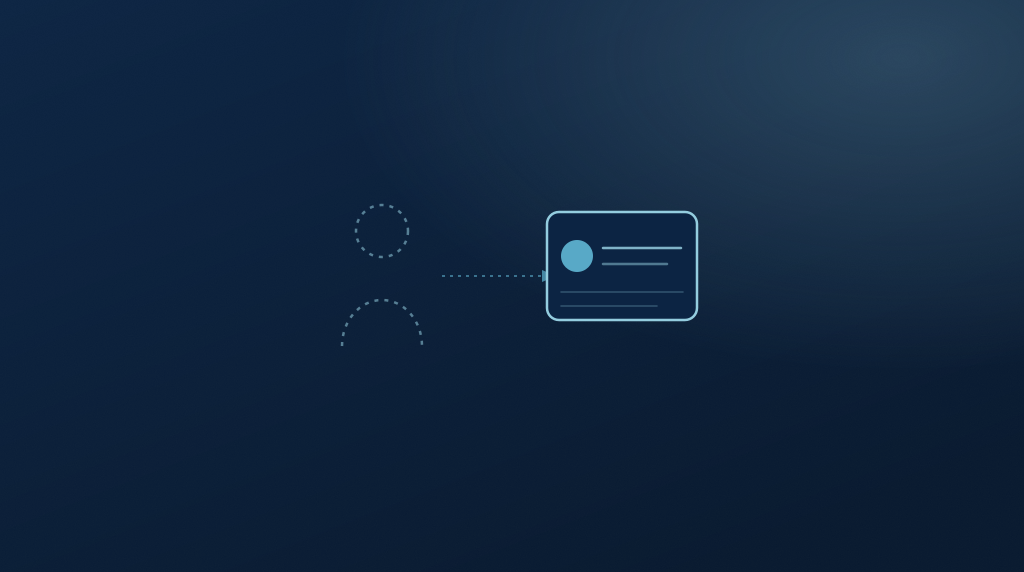
You paid to bring someone to your website — through search, an ad, a listing, a link somewhere. They looked around, maybe read a service page closely, and left without filling anything in. By default, that visit tells you nothing at all. Not their name, not what they looked at, not that they were ever there.
The overwhelming majority leave no trace
Most visitors to most websites never fill out a form, and that is true whether the site is good or bad — filling out a form is a specific, deliberate action most people are not ready to take on a first visit. The problem is not that they left. The problem is that leaving and never being seen again are the same outcome, when they should not be.
What identification actually does
Vizible Leads identifies a share of that anonymous traffic by name and contact detail, using matching techniques that work even where the visitor's browser blocks tracking cookies. An anonymous session becomes a real name, an email, and often a mailing address — a list someone can actually follow up on, built from traffic you already paid for rather than traffic you have to buy again.
The visit already happened. The only question is whether you get to know it did.
What you can actually do with the list
- Retarget by email, social, display or direct mail — through built-in API and webhook access, from a single dashboard rather than five disconnected tools.
- Prioritize follow-up on whoever looked at the highest-intent pages, instead of treating every anonymous visit the same.
- See the pages a specific visitor actually looked at, which turns a cold outreach attempt into a conversation about something they were already interested in.
- Recover the value of traffic that a form-only strategy would have written off entirely.
What this actually looks like week to week
In practice it runs quietly in the background: someone spends four minutes on your pricing page and leaves, and a day later they show up in your dashboard with a name, an email, and the page they were looking at. Nobody had to notice the visit happen. The follow-up — a call, an email referencing what they looked at — happens because the information existed to act on, not because someone was watching traffic in real time.
Speed still matters once someone is identified, the same as it does for any other lead — a follow-up sent the same day, referencing the actual page they looked at, reads as attentive. The identical message sent two weeks later reads as a stranger who somehow knows what you were browsing, which is a worse outcome than not following up at all.
Questions worth asking about your own traffic
- How much of your paid traffic currently ends in a form fill, versus simply leaving? If the honest answer is "most of it leaves," that is the exact gap this closes.
- Do you know which pages your highest-intent visitors look at before they go quiet? That is usually pricing, a specific service page, or a comparison — and it tells you what to lead with in a follow-up.
- Is anyone currently following up on visits at all, or only on submitted forms? If the answer is only forms, everything else is being paid for and thrown away.
This is not a replacement for a form that works
Visitor identification recovers the traffic a form never catches — it does not excuse a form that is hard to find or slow to respond to once someone does fill it in. Both problems are worth fixing, and we cover the second one directly in why your website gets visitors but no leads. Together they close the gap from both ends: fewer visitors leave anonymous, and the ones who do convert get answered fast.
Used properly, contact details recovered this way are for follow-up, not for surprising someone with information they never knowingly gave you — a first message should read as a business reaching out, not as evidence you have been watching someone's browser.
If you want to know what this would actually surface on your own site, a free growth proposal is a reasonable place to start — six questions, no card required.
Frequently asked questions
- How can you identify a visitor who never filled out a form?
- Through matching techniques that work against a database of names, emails and addresses — including on browsers that block cookies — rather than relying on a form submission or a stored cookie.
- What can I actually do once a visitor is identified?
- Retarget them through email, social, display or direct mail using built-in API and webhook access, or simply prioritize a direct follow-up — the details are yours to act on from a single dashboard.
- Does this work if someone visits on a phone with tracking blocked?
- The matching is built specifically to work where cookie-based tracking does not, which is increasingly the majority of mobile traffic.
- Is this a replacement for lead capture forms on my site?
- No — it recovers the traffic that never reaches a form at all. A site should still have a working, fast-responding form for the visitors who are ready to reach out directly.